Friday, 19 May 2023

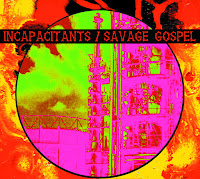
Incapacitants & Savage Gospel CD (White Centipede Noise)


Japan’s Incapacitants have been responsible for some of the most fulsome, bristling, and vibrant noise works – studio recordings but with particular renown as a live act – stretching back over 30 years. It’s often felt like a contest with only one entrant: few have been willing to try and match the efforts of Toshiji Mikawa and Fumio Kosakai.

Finns Savage Gospel bring a continentally different sensibility to the exuberant rush of Incapacitants’ take on harsh noise, but have signalled a clear intent and capacity to produce dense and high volume noise works in tribute – and perhaps in competitive comparison – to the long-standing titleholders. The tundras of Finland give an immediately different sensibility to Savage Gospel’s work compared to the vibrancy of Tokyo’s bustling stimuli, even if the primal power of noise is a common fundamental: the movement and business to Savage Gospel’s work can often occur within the track rather than moving through it, creating a more solid and impenetrable sound compared to Incapacitants’ bustle, when the volume is at 11.

Savage Gospel’s CD opener “Maxihard” is suffocating even at low volume, a slowly vibrating density and seemingly constant block of sound leaving air movement for the wisps of feedback which evaporate from the central mass of oxygen-depriving sound – even as more frantic motions take place towards the rear of the textural hierarchy.  “Missing Peace” and “Shortwaving, Not Drowning” are defiantly different, hollowed-out feedback and a slow low-end boil leading “Missing Peace” to some more familiar Incapacitants-like electronics stutter, before again falling behind a curtain of more static noise which on this track is quite fuzzy and transparent. “Shortwaving, Not Drowning” too finds spatial vibration with a less overbearing frequency expanse, its more demure opening passages again exposing the sickly insides of well-abused equipment, and even its denser bliss-outs sharpening a fierce feedback edge – even finding muscular flex in its obscured mid-range.

The blanketing effect of “Maxihard” causes oxygen to slow and time start to slip, movement imagined as much as experienced. The two remaining tracks open the door and head out into the snow to spar: the cold and dark present but clinging to more discernible movement as that becomes necessary for survival. Both approaches seek to press the listener into submission, but the grim ferocity of “Maxihard” is too good for the other tracks to be quite so effective in their capability to exert pressure.

“Extreme Mother Nights” may not be prime Incapacitants but it carries much of what makes this duo so legendary in its dense and agitated sound, which is somehow both insistently thick and roomily unsettled.  The lengthy live track starts with parts of its insides showing, garish electronics, throttled voice/filter abuse, and an initial nervousness on display all giving a hesitant glimpse into the duo’s instrumentation. But barely five minutes in the set latches on to its full exuberance, variations on a slightly muffled amplifier roar providing unsettling constancy as high-end shards and feedback tempests are repeatedly conjured from the cauldron of bubbling mass.

Even proponents as skilled as the noise world’s favourite salarymen can’t continue to escalate their sound indefinitely and the second half of “Extreme Mother Nights” recognises that, turning on itself hungrily to dig out a quasi-rhythmic thread from its dense shapelessness, before repeated drillings and angry bursts of self-harming blind fury begin to hack away at the greater whole until the set consumes itself to conclude. The gruesome attacks are as fearsome as many an Incapacitants heyday recording, but are not a constant - but rather an emergent strike against the self, each time seeming to leave a bigger hole until exhaustion and self-consumption trigger a final collapse.

It's highly appropriate this CD finds its home on White Centipede Noise, the label a bastion of pure noise appreciation (in addition to being a highly valuable store/distributor) helmed by Oskar Brummel whose enthusiasm and knowledge run deep. Even with plenty of noise around on which to blow your savings, White Centipede Noise – and this CD especially – are highly deserving of your time, support, and precious earholes. It can be easy to dismiss work as imitative or less deserving than pinnacle works (which Incapacitants 1990s output clearly is), but it can also be unfair when original, engaging, and uniquely characterised recordings such as this CD are being released.

Kali Malone @ The Lab, San Francisco, 7 April 2023


My recent trip to the USA was a chance to reconnect with the depths of live underground music which I felt had eluded me since 2020 and the advent of the COVID-19 pandemic. As the world recovers so too does underground and experimental music, but the return of live events – particularly outside festival events – has been slow and selective particularly in making their way to my corner of the world. Good Friday 2023 was an opportunity to hear Kali Malone perform two works principally composed for synthesizer, with a clean and encircling surround sound provided by suitably austere San Francisco venue The Lab.

2022 LP ‘Living Torch’ was an unexpected highlight to the year for me, a pinnacle of the Portraits GRM series which has produced works from an extremely high calibre of artists so far (acknowledging, of course, the legacy of INA GRM and Editions Mego which have merged into Portraits GRM). Kali’s April 2023 set had links to the humanised solemnity of ‘Living Torch’ and the eerie refraction of this year’s ‘Does Spring Hide Its Joy’, while given greater spatial and dynamic movement to befit a more engaged live dynamic.

The first circa 50 minute piece of the evening, which (if my recollection is correct – a troublesome assumption) was a work yet to find its way to a recorded release, synthesised stems provided by cellist Lucy Railton as was also part of the compositional language on ‘Does Spring Hide Its Joy’. Initial monotonic cycles burgeoned with sympathetic layering of synthesizer tones, which then slowly opened into harmonic dispersal and strong low-end thrust – before returning to a minimal place from which to build an even stronger second quake, further shifts of synth adopting the repetitive melodic shape of the underlying string refrain. Over visuals seeming to find microscopic detail in natural elements – a clever representation of the finessing of acoustic sounds which Kali’s work often surveys – the acoustic and electronic elements rose in tempest, before a slow retreat left more fragmented cello off-cuts to bounce against one another to finally quell the extended piece.

The second work of the evening was an eight channel spatial remaining of material from ‘Living Torch’, this time using breathy woodwind tones as the track’s building blocks rather than the tensile strings of the first set. The coarse quality of the bass clarinet notes lifted into its own low grey noise which lurked at the back of the speaker space, treated orchestral lift-outs becoming further immersed with the synth treatments, also starting to peer out from the simpler stereo presentation which started while imperceptibly stacking small interval builds over its clean tones. The result traversed more complex chordalities than the first piece of the night, and was a more diffusive work as well: not done with marking puncture holes from the increasingly dense and pressured-affected acoustic stems, a patina of storm cloud distortion moved in over the increasingly unsettled drone and embraced its tumultuous tangle, urging the piece to an aggressive climax before a retreat into remnant tonalities.

To describe Kali’s performances as drone works, while somewhat true, feels somewhat dismissive and uncongratulatory. The complexity to both, while was slow in affect and trajectory, was in focus and detail on the finer edges of sound, demanding attention as much as immersion. Whether my memory has aggrandised the live works compared to Kali’s sedate recordings, or whether the live setting added an inevitable keener dynamic, I can’t now say with confidence – but regardless the care and detail to Kali’s work easily translated to a live setting and embraced the volume and space of the venue for maximum affect.

Friday, 3 March 2023

V/A ‘Mixed Noise Soup Vol. 1’ C-47 (Satatuhatta)


‘Mixed Noise Soup’ reads as an attempt to encompass the already impressive discography Satatuhatta has amassed in the last two or so years, extracting new tracks from the tentacling Finnish scene which has already proven so lucrative for the highly active label. While the likes of Freak Animal have long championed the depths of Finland’s noise and power electronics capabilities, Satatuhatta seems responsible for a groundswell of material and invigoration of projects associated with the label and its allies, all now coalesced on the label’s first compilation.

Things are stickily wicked from the beginning: Moozzhead’s opening blast casts a virulence which the remainder of the first side can only dream of meeting, thick sheets of rolling distortion compacting the left channel while bleating curls of unrepentant filtration dominate the right, further agitated sounds swarming around in further aversion. The project’s previous releases have favoured a retrovised sleazy aesthetic, and “MILF Command Til War” has both the title and squelching fluidity to match that.  Tyhjä Pää are equally prominent but replace Moozzhead’s sexual splurging with a focused hostility, “Burnout and Repeat” a prophetic title as the track unfurls densely vibrating shards of what may have once been scrap metal which has since been abused and sliced into saturated chunks of high noise viscosity, supplemented by filter sweeps which explode half-submerged like landmines with a hint of Pain Jerk-esque flair - with a crude drum machine interlude adding a drop-out dynamic fault line which somehow only increases the Kohei Gomi vibes.

Beyond those two beacons ‘Mixed Noise Soup’ never disappoints, although (as with almost any compilation) some tracks shine more than others.  The closing trio of tracks ensures the second side is the victor: Mogao’s wet and messy spray of untrimmed harsh noise defiance sweats simple metal bashing feed through cheap distortion, and Umpio’s somewhat similar “Karstanen” pummells several layers of over-crisped electronics, a rutted low-end and spitting high tone constants as the piece frays into trails of unkempt and fired-up spurts of effects-soaked virulence. Scrap Furnace then closes with a piece which could almost pass for recent The Haters material, “Radiant Praxis” cascading metal blows which are thrown into a washing machine and doused with clinging distortion for a bruising experience on par with the duo’s excellent debut cassette (no prize for guessing the label which released that).

Primitive Wings, New Boyfriends and Amek-Maj are as similarly unashamed as Mogao, the latter scrappier but each adopting an eyes shut style of noise intuition which is admirable but which is perhaps a little too uninhibited and wasteful when compared to the more energised and focused tracks found elsewhere on this cassette. While their flurries of self-propelled mastication perhaps give some time to refill your cocktail glass, their crudities are a little shallow when compared both to the excesses of the compilation’s more fervent tracks – but also the less dynamic moments of ‘Mixed Noise Soup’ which demand the listener’s return and attention. Be sure to be reseated for Corral Shut, whose “Rub It To Dry” is an unnerving meditation centering upon raw junk metal scrapes, a distant thudding repetition and blossoms of fountaining feedback ultimately imploding into a flurry of groaning metal grinds and zealous beating: all a close approximation of The New Blockaders’ penchant for raw scrap metal abuse which has none of the excesses of the likes of Moozzhead, but which permeates an oxidized atmosphere which has soaked into many of Satatuhatta’s releases. Resting Place also unfurl a more dismal industrial excursion, a prominent elongated loop casting a heavy machinery shadow over a second background repetition and a sickly feedback tone, which lingers into H.Ö.H.’s second side opener which is equally dismal and repressed, its uneven repetitions unspooling under a thick layer of pleural decay.

Add in a booklet of bespoke art, and collage art seemingly drawn from the social excesses of the 1970s, and ‘Mixed Noise Soup’ is the ideal introduction to Satatuhatta, for those few who have avoided it. Those whose shelves are already overflowing with the label’s riches have another gold bar to add to their treasure chest. I may favour the tracks at the dynamic ends of the compilation, but nothing on this compilation is sub-par: an observation applicable to the breadth of the Satatuhatta discography that I’ve heard so far.

Saturday, 14 January 2023

Small Cruel Party ‘Sic In Se Sua Per Vestigia Volvitur’ C-30 (Chocolate Monk)


I’m an unashamed Small Cruel Party fan: in a world of listening excess the project burrows to the core of chosen items, microscoping into physical objects to extract the awkward and unknown sounds at their centre. While ostensibly working with ambient sounds, Key Ransome has always been more immersive in a Honey-I-Shrunk-The-Audience kind of way: I rarely think I know what is being foraged but the sounds always seem to create expanse out of minutiae, grandeur out of smaller found objects.

It’s rather surprising, then, to play ‘Sic In Se Sua Per Vestigia Volvitur’ and immediately take a step or two back, that previous intimacy replaced with a rocky low-end rumble, upper register twitter and careening filter sweeps which seem overwhelmingly synthesizer derived, and which give side A’s “De La Beatitude Malgre Soi (Pour Daniel)” its dominant formation. While not static, the piece plays on its repetitions and constancies and settles into a singular (if uneven) repetition for most of its playing time, only revealing some welcomingly screechy harmonic tension in the final few minutes.

Reverse side “Par Chu Fait Om Un Angle Tenir Son Doit Ades Vers Le Solel” is a more familiar vernacular, although the tonal ambient drone dominates the physical rustling which quickly cowers to the back. Long-form vocal tones, misaligned rhythm and scratchy synth cast-offs add depth to the piece but again it settles into a comfortability and very little shifts once that comfort is found. There’s something of a simmering industrial tension to the last part of the track, but as with the A side there’s a long and somewhat overwrought lead-in to that modulation which doesn't really reward the outcome.

Focus and closeness have long been central to Small Cruel Party’s work, and while ‘Sic In Se Sua Per Vestigia Volvitur’ expects both it rarely rewards either. Its layered ambience is a less iconic and more mainstream expression of ideas as compared to previous releases, even acknowledging the elongated sound components that have washed across previous releases. The cassette is listenable but quick to dissipate, and without any of the intimacy of Key’s previous work. While perhaps acceptable in isolation, ‘Sic In Se Sua Per Vestigia Volvitur’ withers against the magnetism of Small Cruel Party’s previous decades of personal and more intriguing listens.

Tuesday, 27 December 2022

Astro & Shayne Bowden ‘Live At OTOOTO’ CD and Reynols ‘Plays The Audience’ 5” (Deterra)


‘Live At Otooto’ was released in 2020 but has found its way into my ears only recently, and can’t go unremarked due to tardiness on my part. The disc collects recordings from an evening at Tokyo venue OTOOTO, each performer taking to the stage for a solo set before combining forces in an evening-ending all-in. 

Shayne’s opening set conjures a piercing opening tone which is never let go: as a searing layer of distortion embraces the track its high tone continues to warble through the thick lower frequencies, eventually swallowing the denser sounds to again ring clear. The second half of the piece then alchemises that tone, subtle synth box permutations sending its upper register purity through the tonal wringer in gory slow motion, its initial viscera melted and minced into a throbbing lower spread of frequency bristle. Shayne’s high end clarity, fondness for saturation and carefully plotted movement is sure to please anyone wanting a little more gesture to the work of Rusalka, and his piece is as equally satisfying.

Not to be outdone, Rohco and Hiroshi Hasegawa each turn in transfixing performances. Rohco’s is perhaps the simplest but may also be the unassuming best, opening muffled dialogue snippets and what may be some brief clenches of sheet metal heave the only discernible additions to a series of roughly hewn and overlapped sheets of feedback and slowly tortured analogue effect roar. The set sweats from its own volume as tectonic fissures are coaxed and carefully dragged into position, the weight of Rohco’s textures supporting my vision of their being summonsed from some deeper geologic source.

Hiroshi Hasegawa’s track may not tremble with volume and fear like Rohco’s, but he has adeptly conjured immersive tracks from synths, effects, and sheet metal for sometime, and his contribution here likewise manages to work heavyweight textures with skill, a heavier synth presence and faster pace giving the set greater longevity than Rohco’s tremorous work, and showing Hiroshi’s now innate strength in crafting engaging, fluid, and unforgiving noise. Hiroshi is so productive that it can be easy to forget just how skilled he is, and how lucky we all are to have him still crafting such unrelenting and engaging pieces.

After those successes the final collaborative all-in is somewhat underwhelming; while I’m sure the event itself delivered more, the recording flattens the morass of voices to what is often a saturated flatline, coarse but undeviating blocks of distortion failing to express the depth of the previous solo tracks, let alone deliver the integration of those as would be expected. There are undeniable moments of deeper grandeur but moreso the result is singular and unflinching, only as small collection of moments delivering the depth I would have expected from this three in shared flight. Those scenes of flight do make the trip worthwhile, but after three standout solo tracks it’s hard for this final effort to deliver at quite the same level.

The rewarded OTOOTO audience is sonically absent from the CD recordings, but assume prominence for Reynols’ short-player. Not just present to applaud and vocalise, those reactions are fed into this inevitably brief record. ‘Part One’ seems to process audience reaction into submission, applause becoming a slow wave of rollercoasted breath, with a murmuring tonality and some armament-like punctuation permeating its otherwise billowy structure. ‘Part Two’ seems to be something of a selective backwards rendition of ‘Part One’, only glimpsing its waves of minimal ambience – but adding spoken word and audience reaction first in isolation but then as deepening layers, surrounding the initially simple and somewhat calmative electronics with textural confusion.

I’ve listened to ‘Plays The Audience’ a lot and I’m sure I still don’t grasp its full effect: the rough seemingly audience-made recording adds another titular veneer to the work but also further distances its purport, the simple and effective radiance of ‘Part One’, gunned by its brief staccato interference, becomes a disorienting experience of unmerited applause, jeer and multi-layered voices – but both too sort to make sense of, betraying different sensibilities on repeat listens. There’s an inevitable curio watermark to most 5” records but ‘Plays The Audience’ digs that hole much deeper, ensuring a quizzical experience over one or multiple listens. 

Both releases are still available notwithstanding the limited run of the Reynols 5” and the live disc being a few years old at this point. Deterra releases may not be so frequent but each is done with care and love for the material, something which is clear from both.

Friday, 10 June 2022

Control & Gruntsplatter 'A Fatal Circle' 7" (Raubbau)


There's long been a closeness between Control and Gruntsplatter - in outlook, aesthetic choices, mastering and production commonality, and a shared familiarity with tragedy and trauma. ‘A Fatal Circle’ features a track from each which at least superficially plays to the duo’s parallels, but in doing so ultimately spotlights some of their differences in detail, both specific to this 7” but also more reflective of general stylistic differences in approach, and which permeate the two pieces which make up this split 7”.

Grunsplatter’s “Hunting Extinction” is drenched in melancholy, each developing tone as dark and despairing as the next. The piece opens with synth layers which raise somewhat quickly in register and menace, a dark low-end tone and slowed heartbeat underpinning the upper register movement, eventually multiplying into a larger swarm of synth voices which emerge from expanding cracks within the original inputs only to distort, warp and burn when exposed to air. Even with a heavy immersion of distended mid-range tentacles emerging from the unsightly central mass, ugly low-end upset and hints of uncomfortable high-end screams are flung from the middle of the piece like satellites destined for solar system reaches only to eventually become unreachable as they drift further from the centrepiece of seething blackness.

Control uses similar compositional elements but adopts a more forceful and direct approach. “In The Blood” finds a similar bradycardic pulse, before adding indecipherable vocal utterings which are cloaked heavily in effects whenever they emerge from the miasma of the piece. While there’s a symbiosis to the dark heart of both pieces on this 7”, Control commands a greater segregation of components and a more threatening aura, in particular found in the storm clouds of low-end tinged vocals of the opening which explode into a more familiar explosive hostility later in the piece. Linked to those sprays of vocal upheaval are uprisings of bleak electronics which explode from the seething electronics are the core of the piece, escalating the depth of the piece as each syllable is screamed. 

While there is a central shadow to both pieces, Gruntsplatter explores the unknown and uncertain whereas Control finds hints of structure, melody and a more defined purpose to the portions which make up its side. Both sides circulate dark semi-tonal elements, however Control seems to pre-empt and allocate the sounds in a more regimented approach – while also remaining mired in a compared to Gruntsplatter’s reactionary interferences. The differences in approach don’t affect the outcome, however: both have summonsed a deep and gloomy mass of death industrial electronics in a manner consistent with the innate sensibilities each has, their core differences in approach encouraging quite personal six minute expressions.

The 7” is limited to 100 copies, abandoning some of the intricacies of Raubbau’s recent releases for a black sleeve adorned with geometric distress in thickly textural paint: fitting perfectly with the more extreme and bleak end of Ant Zen/Raubbau’s interests and picking up the label’s preference for bold and layered aesthetics which are consistently striking and well-realised: the recent run of harsher sonics is a welcome dark cloud across the label’s mix of underground genres, with the label’s strong design and quality control both reasons to trust this release even if – and what the fuck? – you’re not already familiar. 

Sunday, 1 May 2022

Blood Incantation 'Timewave Zero' 12" + CD


When seeing Blood Incantation support Arcturus in 2017, little did I know the Americans would be the ones to thereafter be responsible for best probing the galaxial reaches – notwithstanding the Norwegians' long and respectful career of astral aspiration  as Blood Incantation’s amazing 2019 full-length ‘Hidden History Of The Human Race’ in particular drove the quartet beyond immediate orbit to comb the stars for suitable confrontation. While the group’s renowned death metal explorations have looked for alien life to end our own, ‘Timewave Zero’ sheds the metal instrumentation for an array of synthesizers and integrated analogue electronics, used to wind out long-form meditative compositions which betrays the realisation that the weight of the universe can crush humankind without extra-terrestrial intervention.

Opener “Io” builds steadily on its opening synth drone, further tonal layers added repeatedly as its base elongated tone is used to trigger thriving layered drone, smaller synth flickers and light  , before blossoming into a melodic arpeggiation which flickers the underlying drone to life, finding a contour which supports the upper register as it reaches full Tangerine Dream worship mode. Even when the piece returns to an unchanging droned note it can’t escape the tender chordal shapes which have now emerged, with subtle waveform shifts and derivative melodic shapes opening space for lingering acoustic guitar to weave its own chordal shapes into the trembling synth layers.

Second side “Ea” launches straight into those familiar arpeggiated melodies, additional single note lines supporting that shape with the piece maintaining a greater momentum than “Io”’s peaks and troughs. Even when the synths decline in “Ea” there’s a more active acoustic guitar added to pick out the piece’s ongoing chordal refrain as the melody line remains with the synth (and what I think is a subtle gong is added in the distance), before returning that task to the electronics with some classic dense synthesis and slowed discourse, before descending into a final tonal melt. While neither track is better or worse for it, “Ea” has a more homogenous approach than “Io”, perhaps hitting a more intuitive or familiar shape than “Io” which binds “Ea”’s parts tighter than the wave forms of the first side.

Get any of the vinyl pressings and you’ll get a CD of the same material. However the CD/blu-ray set includes an additional track, “Chronophagia” – also locatable with some resourceful YouTube-ing. The additional track flows with a distinctly darker Lustmord-ian hue or pallour lifted from Klaus Schulze’s bleakest solo work, shadowy electronics underpinning a more inhibited effort than the album proper. The strong arpeggios of “Io” and “Ea” emerge only hesitatingly and nervously, muted by “Cronophagia”’s swelling central desolate tones, thick fumes of displeasure, and comparably uncomfortable harmonic profile. The billowy profile of the piece seems to be hiding something, and it eventually that proves correct: as the smog clears a languid melody emerges with strong overtones of Vangelis’ ‘Blade Runner’ soundtrack, supported by a clean upper register piano refrain and remnants of the group’s still smouldering electronics. If “Io” and “Ea” give the impression that space travel was some stream-of-light euphoria, “Cronophagia” is a reality that the travel is one of isolation, darkness, and emptiness: for all their far-flung searches, Blood Incantation are still confined to the same flesh vessels as the rest of us.

‘Timewave Zero’ wears its influences boldly and plays to them closely, even down to the meditative outdoor scene in the gatefold which could easily have been plastered inside ‘Ricochet’ or ‘Encore’. The reaction from those looking only for more of what ‘Hidden History Of The Human Race’ offered, is predictable albeit understandable, but the chance to do something different – and do it convincingly – is for me even more exciting.  With its intentionally regressed soundset ‘Timewave Zero’ is a break from expectations but also cleverly within idiom, opening Blood Incantation up to further exploration and ambition whether they break from their tradition again or not.

Tuesday, 19 April 2022

Kazumoto Endo & Boar 12” (Peyote Tapes)


When I first heard Kazumoto Endo’s work – I’m pretty sure it was “Most Of My Problems Are Solved By An Afternoon Snooze”, his split 7” with Incapacitants – I was immediately affected by the gravamen of silence, the way a return to volume can make a sound more powerful than were it sitting in a cluster of similarity.

“Homebrew” reflects an updated wisdom from Kazumoto Endo, initial tracts of silence quickly perforated rather than left hanging, part of a multi-faceted experience in which forceful blasts of chopped-up high end discharge are incessantly and unpredictably fired into the air. Initially that strafing encounters relative calm, but as the piece entrenches those uncomfortable silences disappear, removed by what at first is a layer of secondary skirmish with effected scrap metal but what builds, through an acquisition of rapid loops and further magnetised attractions, into a surrounding arsenal firing of backup weaponry; and while resolute in mirroring the frequency profile of the dominant shares of brutalised focus, playing “Homebrew” out also sparks hits of liquefied low-end shudder which add an unexpected haunt to the central shrill tones. The silences which first drew me in are still there at the end – but found within layers which are overlapping others, and which are themselves feeding into Kazumoto’s increasingly hectic and crowded palette.

In comparison Boar’s sounds are far more flayed and finessed, whittled down to highly charged fragments of noise which have been intensely scrutinised, diced, and splayed across the stereo spectrum. Highly processed contact microphoned refuse seems a vase source of choice, but snippets of synth, manipulated feedback, and pure noise saturation all feature, lapsing into occasional loops but more often tumbling in free-fall, discarding cut-up components as it descends unpredictably and unhesitatingly. Single toned scrap metal crunch can give way to sonorous oil barrel thud, and seemingly inconsequential refrains find themselves double-tracked and spotlighted, all part of Boar’s microscopic focus and keenness for upset which propels “Metal Bound Flesh” in its reckless orbit.

It's not just the effort which has gone into shaping the sounds and micro-sounds, but the frantic pace of their unravelling and the segues into uncertain calmative moments which fill sudden moments of space. Boar has poured everything into “Metal Bound Flesh” and it shows: the piece is among the most finicky modern cut-up noise you will hear, riddled with detail and burning with momentum.

While sharing technique, both artists use it for different means: Kazumoto Endo’s side builds in size and intensity as it piles components; Boar sheds its parts as fast as it accumulates them, throwing components into the void as it hurtles forwards blindly but firmly in control. Both more than achieve their purpose, making this LP a standout not only for their respective technical abilities but for how those skills are used to achieve a much cleverer and listenable aim.

Thursday, 17 March 2022

Nurse With Wound ‘The Hovels Of The Rich Or The Rigid Digit’ 3”CD (Lenka Lente)


‘The Hovels Of The Rich Or The Rigid Digit’ marks the tenth collaboration between Nurse With Wound and French publisher Lenka Lente, their history found across a succession of 3”CDs paired with short books authored by historic European writers including Frank Kafka, Antonin Artaud, Adolf Wölfli, and for this volume French writer, journalist and pessimist Alphonse Rabbe. The discs have afforded Steven Stapleton’s modern guise opportunities to work on a short-form piece (usually around 10 minutes playing time) within an ostensibly abstracted format, and the previous discs have sat in a comfortable, and I wonder if somewhat overlooked, fringe to Nurse With Wound’s ever-expanding discography.

For this release the book is again in French and with no translation, so any ties between music and text are for me at least imagined. Just perhaps Rabbe’s withdrawal from society is mirrored in the choice of intangible murmurs which are fed into Nurse With Wound’s piece, but I doubt it: that kind of attribution would give every experimental artist an immediately vague lofty literary link, and I put Nurse With Wound a step beyond that. The connection between Rabbe’s drug addiction and Nurse With Wound’s recent ‘Opium Cabaret’ CD and LP is probably coincidental, but ‘The Hovels Of The Rich Or The Rigid Digit’ does fall broadly into the ambient bracket of Steven Stapleton and Co’s work – although without the drama which makes ‘Opium Cabaret’ one of the standouts of modern Nurse With Wound.

Rather, this 3”CD is a more serene and stagnant work, emphasising a higher frequency register to remain in the air at all times with a simplicity and glissando of movement more in line with a truncated ‘Soliloquy For Lilith’. The opening delicate shimmer quickly opens up a broader and loosely cycled clutch of tones, concocted tones seeming to merge with slowed and shaped acoustic material in the way of bowed cymbals or resonant piano strings, the interplay of effected and organic constantly difficult to separate and made even more difficult when a subtle layer of further manipulation emerges from the digital concrète rattling which lurks in the shadows of the piece. Those soft tonal interplays continue as the piece dilates slowly and incrementally, the upper register tones kept prominent to obscure a diaphragmatic lower register drone which adds a barely perceptible weight to the piece. Even the piece’s climax doesn’t break the slow drift of the piece, an arc of more urgent staccato clattering and even a rare glimmer of feedback with the electronic tones failing to ignite the gaseous elements of the piece.

Unlike ‘Opium Cabaret’ the detail to ‘The Hovels Of The Rich Or The Rigid Digit’ is much harder to extract, and it’s easier to appreciate the piece in its drift rather than in the finer elements which are there to support the larger structure. It wouldn’t necessarily make for a strong full-length work, but Nurse With Wound’s latest Lenka Lente creation works well as a short escape into the atmosphere with which to return and pick up something else. There’s no doubt Steven Stapleton is skilled in immersive ambience, and ‘The Hovels Of The Rich Or The Rigid Digit’ is proof even if some of Stapleton’s stronger skills are responsible for subtler elements which sit around a perhaps simpler central drone creation.

Wednesday, 9 March 2022

Sewer Election ‘Horse Utopie’ CD (iDeal)


Sewer Election has aced a number of different sub-genres while blazing through the noise underground for over two decades, and Dan’s current productivity and proficiency has produced a staggering breadth and quality of releases in the last couple of years which – coupled with a penchant for micro-edition obscurity amongst larger release set pieces – is even more difficult than ever to fully appreciate.

‘Horse Utopie’ is not the moody disintegration of ‘Skärvor Av’ (LP on Second Sleep) or the dense noise punishment of ‘Glorious’ (cassette on Receiving Vault), and it’s nowhere near the soft synth pleasantries of ‘Psychic Panorama’ (CD on Discreet Music) or Dan’s intriguing collaborative endeavours; instead the CD revels in instantaneous harsh noise, a looser noise exclamation seemingly crafted from live-to-disc sessions and finalised with minimal further intervention which in the project’s early days would have perhaps been used as cut-up fodder but is presented here intact.

Opener “Filter Wound” delivers on its title, skin gashes opening up as contact microphone stammer bolsters a scrappy distortion line which steroids up into thicker and more virulent surges of free-flowing noise sensibility and a largely confined mid-range emphasis, until some breakout high-end synth ignitions and a subtly booming low-end spring from the piece in its final minute or so. The track is linear and constantly developmental, its shifts in tone and emphasis coming from the unseen changes in pedals permutations, but all well buried behind the waves of responsive distortion in which the remainder of the piece is immersed.

Interlude “Dripping Star” strips back most of its rumbling distortion to reveal internal workings of squelching synth, almost slowing to a standstill before hits of blown-out junk metal ravage the piece: the same elements which one suspects drive ‘Horse Utopie’ throughout, but removed from the effects chains which clothe the remainder of the disc. The raw junk metal is pleasing in a CD otherwise light on any identifiably physical sound sources, but particularly so for its torrential quality, swamping the second half of “Dripping Star” in hostility.

Final track “Carve Mono” is the peak noise exaltation, digging deeper and pushing longer (well over half the disc’s playing time) to fill out the frequency profile by running what seems to be two independent or semi-independent effects chains while also spending most of its playing time in a far more invigorated state than “Filter Wound”, this final piece surging as its lines engorge.  Passing clumps of burned-out filter sweep, strangled feedback, thumping contact microphone disruption and blasting synth warfare all become dangerous submersibles in an unstable and unpredictable divergence of competing torrents of coursing distortion, which is susceptible to constant frequency adjustments and captivates a surprisingly strong undercurrent of grittier mid/low range grind.

‘Horse Utopie’ seems to do away with the deeper statements and explorations of other recent Sewer Election releases, instead existing with a certain “because I can” pugnaciousness stemming from its innate creation. It exists for its own sake, and in celebration of what immediacy can bring to harsh noise; learning from the compositional aspirations of other release but ultimately born from fire, finesse and freedom. Without the deeper motivations of other Sewer Election releases I had initially thought ‘Horse Utopie’ may suffer, but the opposite may actually prevail: the disc is motivated by an appreciation for pure and immediate noise making, without needing any further purpose.

Friday, 25 February 2022

Aube 'Hydrophobia 1993' one-sided 12" (Cheeses International)

‘Hydrophobia’ was the first Aube release, a single-sided cassette on the indelible Vanilla Records, staging what would become Akifumi Nakajima’s well-known long buildup, sounds derived from water looped, layered and distorted into a drowning torrent. The release is raw and quite raucous, opting to focus on a fearsome force of fluid which is itself soaked in distortion, the movements of the liquid resonating as crisp fissures in the rushing noise which overwhelms the piece.

‘Hydrophobias 1993’ is a previously unreleased redo of that early missive, a recreation of the original side through a different lens and time, similar to the early remix of ‘Submerged Tension’ which saw release on G.R.O.S.S. after a debut on Steeple & Globe. Here the piece is sieved from a somewhat murkier body of water: the fulsome distortion of the Vanilla tape is muted somewhat, the highs not as biting and the low frequencies emerging as muddy thrusts rather than the encompassing flow of the original. The comparison is perhaps a bit unflattering to the later recording, even if that same revelry in coursing noise is equally present on the remix even if reshaped in its course, and the immersive rush of the original is lost somewhat, replaced with a murkier experience littered with semi-submerged uncertainties.

In comparison to the original the lead-in is however more developed, a soft introduction of bathyscape heartbeat syncing into a clanging repetition and muffled low-end rumbling, an initial flurry of noise then winding down into a cantankerous buzzing loop quarantined to the left of the stereo spectrum, allowing more deep sea atmospherics before the centrepiece of gristly noise emerges fully.

It’s understandable this piece wasn’t released in 1993; it’s somewhat regressive when compared to the more refined work Aube had already uncovered in the two years since the  first ‘Hydrophobia’; this 1993 revisitation also travels a less obvious trajectory than the initial tape, missing some of the original’s peak saturation. But as a relic to dig out in 2021, ‘Hydrophobia 1993’ is quite the find, and a welcome bolstering of Aube’s body of work. If you don’t have ‘Hydrophobia’ it’s the better place to start – and I think still available from Vanilla after all this time – but this redo occupies its own space and is a very digestible listen: I spun it at least ten times the first weekend it hit the turntable.

Thursday, 27 January 2022

Trajedesaliva ‘Ultratumba’ CD (áMARXE/Ferror Records/Gradual Hate Records)


Trajedesaliva is the Spanish duo of Mon Ninguén and Una Vena, ‘Ultratumba’ being their fourth release in a discography spanning over twenty years. Previous releases have featured an expanded lineup and strong flourishes of jazz, demure electronica and low-key gothicism amid its spread of occasionally avant post-rock ambience.

‘Ultratumba’ channels those sensibilities into a refined instrumentation of synthesizers, electronics, voice and drum machine, losing most of the peripheral genre influences but retaining a flair for the unexpected; it’s taken me far too long to write this review because ‘Ultratumba’ has proven quite elusive, its different shades seeming to take on different prominence almost every listen.

Parte 1 opens with soft synth pads which quickly circle around a John Carpenter-esque melody and synchronized bassline/drum machine, a slow and chilled atmosphere wafting from the opening pair of tracks which are heavy in recent synth revivalism. The opening pair of tracks set a refined and carefully gloomy scene, a tone which ‘Ultratumba’ ultimately prides itself in destroying. The focused instrumentation is a constant, even if this CD varies its intentions at crucial points: my varied reactions reveal three quite distinct moments within ‘Ultratumba’, which assume different emphasis on any given listen.

That graveyard twilight stroll quickly turns to moonless night fright, and with a few spoken words “Familia Ferro” shifts into dark noise and billowing shadow movement overseen by a menacing higher tone, with strikes of grainy industrial faux-percussion dissolving into dead TV static which hints at drowning musical tones as part of the piece’s peak of midnight terror. “Arenas Calientes” keeps that fear-motivated clench while returning to a more familiar dark ambient layering to its synth tones, Una’s whispered vocals rattling through the piece.

The mood of ‘Ultratumba’ shifts again for Parte 2, dominated by looser synth melodic noodling, lengthier spoken word passages, sections of upbeat rhythms, and an overall far more positive sensibility than Parte 1 was willing to admit. I admittedly detach from ‘Ultratumba’ somewhat here, both because Parte 2 sounds more repetitious in its ideas and execution – “Mammillaria Sempervivi” and “Queremos Verte” in particular work a very similar set of ideas – and because of the lighter tone to this second half of the CD, the John Carpenter references shifting to mid-period Tangerine Dream: it’s far easier to slip out of focus as Parte 2’s warmer tones set a more relaxed and unthreatening environment.

The day/night shift of ‘Ultratumba’ may be a little too distinct to draw fans to both halves and keep them there, but in selecting a refined bank of instrumentation Trajedesaliva tap into a more honest and available expression than their earlier releases ever achieved. Whether Trajedesaliva should sacrifice both sides of ‘Ultratumba’ to choose dark over light or vice versa, I don’t know; the tonal shift gives depth to ‘Ultratumba’ but also effects a delineation Mon and Una may struggle to reconcile moving forward. I don’t necessarily want the diaspora which ‘Ultratumba’ effects, but I’m inherently drawn to works which straddle contradictory emotions and realisations – and for that ‘Ultratumba’ deserves the repeat listens it’s obtained in my house, even if in part motivated by a want to revisit particular moments which gained emphasis on a particular playthrough.

Tuesday, 16 November 2021

Blackphone 666 ‘PTN.YLW HARM’ C-60 (Murder Channel)


The local whispers about Blackphone666 were keenly amplified when 2017’s ‘Accumulation’ CD (Dotsmark) brought the project’s furious electronics assault to the wider world, heralding a project born in the ‘00s and more than capable of shouldering the weighty expectations of Japanese’s unrivalled noise and experimental history. Seeming to rise from the fringes of underground dance culture and comfortable with its millennial sensibilities, ‘Accumulation’ balanced flow and fracture, structure and deconstruction, with ease.

‘PTN.YLW HARM’ is something of a stop-gap release, perhaps more a collection of ideas than a fully-fledged full-length, and the release proper – the first side of this cassette edition – is steeped in highly paced gabber beats: flurries of hyper-charged rhythms which dominate the pieces and leave minimal space for the project’s fearsome storms of noise electronics. Those happy to merge their harsh noise with the fringes of extreme dance music may be pleased, but for those – like me – who extract nothing from that scene, this cassette’s almost garish embrace of kinesis weighs in favour of an artform of no attraction.

While cruel squeals of gory harsh noise are emitted on occasion, that lifeblood is obscured by the incessant beats which festoon the first side of the cassette. “Aspect Of Disorder” hits pause on the drum machine long enough for some sickly cries of volt surging electronics, and “Blood Stocks” dials the rhythmic elements down a notch or two as a threshing line of noise flails away in stereo left. It’s too little to properly latch on to for those wanting a further dose of what made ‘Accretion’ so good, and in my view let down by the rigidity of the beats which offer few detours or variations: once the beats hit they remain, trampling out almost all other activity.

The exception to this glut of pushy one-two is final track “In Your Area”, which slows the rampant beats down to a less fevered tempo, before infusing that gait with ashen synth swatches and hoarsely yelled vocals for a far darker and more confronting finale compared to the fast-forward dancefloor overload of the remaining tracks. After 24-odd minutes of frantic flashing of brightness, the constriction in atmosphere and immediate dimming brought about by “In Your Area” shows some lost potential to Blackphone666’s strobing pulsations.

Bonus track “Believe” isn’t for download but is exclusive to the cassette, and takes up the entire second side. The rhythm is distilled down to a snappish pulse which lurks at the edge of the mix, layers of crunchy distortion taking up the space it was denied over the pieces on the first side. The long-form piece hits an easier and more staid tone, rasping sheets of noise scuffing strongly while higher frequency bubbles float through the airborne grit and, as the piece develops, more intense lashings ignite the dormant fuel within the piece and lurch it out of its largely unthreatening course.

Every project is entitled to explore its origins and crevices. ‘PTN.YLW HARM’ tributes a world I’ve never wanted to visit, and was never going to bring me along for that ride. The moments of upstart noise obnoxiousness hint that a return to darker and more nebulous concoctions is intended, so while this cassette is destined for the shelf in favour of its predecessors, I don’t criticise the attempt – even if the outcome leaves me behind – or abandon my hopes for Blackphone666’s future plans.

Friday, 1 October 2021

Azoikum & Scatmother ‘Holden Caulfield’ C-70 (Nil By Mouth)


Stefan Widmann’s Azoikum has emerged from the ice, pushing out a number of releases in the last couple of years which show no sign of degradation from the time spent away. The project is coupled on this cassette with Scatmother, an outlet for Hagen Verkhaner which straddles primal noise and sordid power electronics for an intentionally unsavoury sensibility which has played out across a range of releases since the mid-‘10s. The two are united here on ‘Holden Caulfield’, the central character of JD Salinger’s ‘Catcher In The Rye’ and used here presumably as a banner for the character’s mental illness and instability which is faintly threaded to Scatmother’s chosen samples.

After a demure introduction Azoikum launches into a fury of tangled and fried noise electronics, multiple lines boiling furiously in a clutter more reminiscent of mid-90s American or Japanese noise than anything else I’ve found in Azoikum’s discography. Drifting away from the project’s more familiar power electronics dourness has not hurt this material at all: it’s powerful, absorbing, and bleeding confidence, equipment punished but clearly enjoying the force deployed upon it.

There are very few sonic components from Azoikum’s material which I can identify or grasp, with only small fragments finding recirculation through a wider reinventive momentum – but that’s the point; this is noise with the futurist drive of Merzbow’s ‘Relapse-era’ but in a somewhat more confined frequency range (there’s little low-end to kick in, and the high end sheen has been kept dialed back), a way to get from beginning to end quicker and with more bruises than the time/space continuum wants to allow. The project’s well-worn power electronics lexicon shouldn’t put off those wanting a fix of high velocity harsh noise: this material is highly satisfying, and stands up well to repeat listens.

Scatmother finds inspiration in a sparser but still disheveled swamp of noise, with leaky feedback, scrap metal and buzzing synth resonating through a darker and more muted display than Azoikum’s bolder hues, and lashed on most tracks by hoarsely yelled vocals which seem to rage in response to the flames coaxed from the familiar setup. At its best the material surges and swarms with invigoration, effective in its brutishness and forging its way through crude weight and nastiness. “Breeders” and “Kshattriya” are both beneficiaries of this approach, ugly distortion-smothered junk and crude synth adjustments  giving a sense of unhinged immediacy which the vocals perpetuates.

It's not an approach which always works, particularly at over half an hour in length. “Proud Flesh”’s ominous opening of delayed junk metal scrapes and unflinching synth sets a more stable and effective tone but that falls apart when the gruff vocals and squirming electronics interject, however the drop in intensity is palpable; “Asperger’s Syndrome” follows and is similarly unconfrontational, the immediacy and abandonment of the better tracks waning through this mid section, unable to keep the energy or depth of sound which gives the better tracks their edge. I prefer the project when it maintains a mood at the expense of ferocity, rather than the other way around; the contributions to this cassette are enjoyable enough when at their peak, but the unevenness and drops in intensity push ‘Holden Caulfield’ back in Scatmother’s discography for me.

Nil By Mouth’s expansive packaging should be well-known by now, and ‘Holden Caulfield’ is the label in its sweet spot: an oversized envelope housing multiple inserts alongside the cassette. Visually the materials are well-made, although the link between what I assume are the Azoikum inserts, and the audio material as titled, isn’t particularly clear: none of the titles match, and the themes seem a little misaligned. Regardless the presentation is a treat, a few rungs above the crowd of Norelco cased cassettes.

Wednesday, 18 August 2021

Red Wine And Sugar 'Donkeys Are Led By Donkeys' 10" (Index Clean)

Red Wine And Sugar is the duo of Melbournians Mark Groves and Samaan Fieck, a melding of (as the promo blurb accurately states) “drily delivered text and concrète sound”, found across a small collection of mostly locally released discography entries which have matched Mark’s texts with experimental conjurations seemingly derived from slowed and abused tapes and related media. ‘Donkeys Are Led By Donkeys’ is the duo touching base during 2020’s covid-19 city lockdown, connection as a duo attained through societal and musical disconnect and the sound components then delivered to Altar Of Flies soundsmith Mattias Gustafsson for a reworking on the record’s B side.


The untampered recording of “Donkeys Are Led By Donkeys” starts sparsely, words hanging from silent hooks before being bolstered with a grab-bag of left-field sound. A free jazz sensibility courses through the piece’s sonic choices as discordant jabs, raw guitar clumps, an almost sleazy percussive pulse and a wheezing hum are all shaped through the piece’s opening few minutes, before hitting a cloud of darker murmur which is allowed to close the piece out. While the duo have never been confined in their sound inputs, “Donkeys Are Led By Donkeys” seems more openly musical in its backing, thieving what could easily be The Mount Fuji Doomjazz Corporation off-cuts to stitch together an experimental home bar version of early morning jazz ambience for Mark’s words to hang off in lament.

The unflinching and unhurried vocal delivery – a constant to Red Wine And Sugar’s discography – echoes the isolationism of the cover, fragments of bubbled-up dysphoria and covid lockdown reportage growing increasingly abstractified with a Burroughs-ian cut-up sensibility to its prose, a sensibility finding reflection in the lyrics’ visual treatment on the front cover. Mark is a careful and evocative lyricist and “Donkeys Are Led By Donkeys” is another layered text which has both superficial resonance and deeper intrigue.

Mattias Gustafsson’s remix/reimagining of the track on the B side mistreats grainy cassette drone with mangled tape hiccups, hiding a distant depth of sound and collection of junk ephemera in its haze which has more than a hint of Nurse With Wound’s murky drone depths. That opening resonance is swept aside by the spoken word returning, a concise staccato to the underpinning sounds maintaining a busy trajectory but still imprinting space around the concrete sounds. The urgency which builds through the original track is gone although its sonic remnants remain differently accented and ordered, with muffled junk caterwaul, Leone-adjacent guitar punctuations, close-microphoned crumpling and disquiet cable hum all finding an irregular cycle at Mattias’ hands.  The spoken word too is subject to degradation, irregular effects and mangled repetitions adding uncharacteristic tone to the project’s usual indifference.

The generation of space within the remix, its opening celebration of error and shadow, and its choices of fragments to limpingly repeat, make the treatment a welcome and distinctly different addition to the original piece, various qualities emphasised and abandoned in addition to the introduced sensibility of the opening. Red Wine And Sugar has always been an intriguing and unique project and ‘Donkeys Led By A Donkey’ furthers that of its own accord, but accented by Mattias Gustafsson’s characteristic imprint.

Wednesday, 21 July 2021

Merzbow & Prurient 'Black Crows Cyborg' 12" (Hospital Productions)


Both pervasive collaborators, the stylistic strengths of Merzbow and Prurient have – to my knowledge – never met prior to this LP, each previously staking out quite different territories even across sizeable discographies which both traverse a wide experimental ground. Nonetheless the shared aesthetic of ‘Black Crows Cyborg’ is immediate and maintained, an acknowledgement of the negativity of familiar environments which finds the collaborators bound to a common experience which manifest in different concerns on each piece.

Side II’s “Cylinders Raven” is how I expected the collaboration to sound, opening grounding buzz and scrap metal soon enveloped into Masami Akita’s nihilistic sprawl. Recent Merzbow has – when in outright noise mode – tended for dark, charred distortions, and to this Prurient adds a fractured unease with blisters of synth thud and shudder and fragments of crude electronics thrown across the stereo spectrum, the layers contorting in an uncomfortable flux as Dominick’s contributions swim through the bloodstream of the piece, met with hostility by Merzbow’s midnight squall.

Superficially “Cylinders Raven” wants to be as relentless as most of Merzbow’s recent harsh noise fluidity, but beneath that surface Prurient plays a strongly divertive role, objects thrown in to divert and ultimately reduce the current, the second half of the piece in particular retrogressing to the junky crudity of 1980s Merzbow as half-alive electronics, scraps of angular metal, and whirlpooling distortion all float in a few inches of soupy gloam, with the depth of the work only revealed at the end, layers stripped away to reveal single elements which were clouded by the larger work billowing from the speakers.

Side I’s “City Barbarism Melancholy” brings clearly owned elements into a very different collaboration. A moody chordal drone hangs in the air like a Charlemagne Palestine concert leaking through a closed door, as independent lines of junk manipulation wrestle on either side of the stereo spectrum, and occasional fissures of pressurised electronics and near-white noise flare up at or near the surface of the piece. While “Cylinders Raven” compacts layers to keep out the light, “City Barbarism Melancholy” breaks the skin of a penetrative melancholy, its intangible drone hanging purposefully out of reach while its scrap metal blows are intentionally raw and bruising. Meanwhile the spurts of angry noise which fall across the piece are swept away by the pervading atmosphere, ejections of pent up despair which quickly fall back into the singular mood which motivates the piece.

Notwithstanding the cities attributed by the liner notes to each piece, I hear each artist studying the other's experience: of Tokyo’s fast pace but problematic underbelly, its problematic elements attempted to be swept away but remaining once all is gone; and of New York’s flashes of immediacy sinking into an isolating experience even when hit by a crowded, unkind jostling nearby – as well as that of its artists who have dug into their histories as well as expressing their modernity, blocks of their respective discographies revisited for quite prominent components of the LP even as a common gloom settles over both collaborative sides.

The presentation of the LP draws the listener into that too, mangled and painted mesh (which has been highlighted with a matching embossing), trash circuitry and electronics refuse all strewn across the cover, and splatter vinyl furthering the effect. I find something rewarding to ‘Black Crows Cyborg’ every listen; sometimes new, sometimes revisited – furthering the urban references which influence the LP – and there have been a lot. The two have managed to create a work in which each collaborator’s materials are easy to discern, but which feed a larger whole which works as its own creation.

Wednesday, 14 July 2021

Blessed Sacrifist 'Loss Of Innocence' CD (No Coast/No Hope / FTAM)


Emerging from an ever-deeper sea of east coast American power electronics/death industrial projects, Blessed Sacrifist pushes genre affiliations with black metal in a manner not underlined so heavily since MZ.412’s mid-1990s desecrations. Clean and simple lines dominate ‘Loss Of Innocence’, evoking the wracked despair of black metal at its misanthropic core: the slow descent and raw vocals of the genre’s depressive introspection, and acknowledging an almost religious solemnity in the treatment of its cold melodies and stripped back textures.

The mission statement is “Isolate Form”, a minor key chordal repetition the building block for an intense, melancholic hymn escalated by fraught vocals and swarming synth. Like all of ‘Loss Of Innocence’ the brush strokes are wide and careful even if the only colour is black, the piece’s ten minutes layered slowly and carefully, baring its musical inspiration across a confined death industrial instrumentation. “Failing Grasp” balances those same sensibilities just as skilfully, blending spook and melodic frown with the darker end of the Berlin School output: the back-of the-classroom synth somnolence of Tangerine Dream’s ‘Zeit’ and Klaus Schulze’s ‘Cybotron’ cast into a burning church.

Bludgeoning elements give ‘Loss Of Innocence’ its peaks, a suffocating opening to the title track drenched in blast beat admiration and manifested as textural saturation, and climaxing again through “Eclipse Of Winds (Forward)”’s immolating distortion which lays waste to the second half of the piece: a track which also veers into full musicality with its opening two chord riff, a poorer overt recognition of the release’s spiritual genesis than “Clandestine Despair”, a stand-alone minor chord arpeggiation which is slightly out of tune and dullened with a strong hint of Carpathian Forest’s early atmospheric pieces. The musical detail is a little flat, but its inclusion is important to fully explain ‘Loss Of Innocence’.

What these tracks expose, however, is the slow pace to the CD: an intentional reflection of the cyclic dysphoria which has haunted black metal since Burzum. Like the dispersive sub-genre it evokes Blessed Sacrifist’s languid and repetitive nature can sink into tedium with the wrong listener or mindset: the focus on mood is paramount, but when not shared by the listener the work can drag in various settings and at different stages of immersion. It’s a message I share some times, but not always: when not fully committed to its atmosphere my point of departure – and while still impressed by its clean and harrowing delivery – is the length and repetitive simplicity of the pieces.

Tuesday, 6 April 2021

Nunsploitation & Milat 7” (Innercity Uprising); End Project & Ebola Disco/Browning Mummery 7” (Novichok)


Even if I admittedly don’t retrieve them from the shelves as often as I should,  split 7” records remain a favourite format for the unexpected and unknown: a chance to use a physical divide as a stylistic wedge, and pair the known with the unfamiliar, the old with the new, or the rote with the experimental. This pair of split 7”s cross many of those divides, drawing projects from within Australia’s current noise/industrial scene.

Innercity Uprising have already released a handful of split lathe-cut 5” records with house band Milat, now upgrading to 7” size to pair with Nunsploitation, a mysterious Melbourne project featuring members of Military Position, Shallow and Expurgatory with only a few recordings and live performances to show for their four years of existence.

Drawn from the group’s debut live performance Nunsploitation’s “Milk” plays it safe both for the format and compositionally, a steady pulse of bass guitar washed in grubbier distortion and threatened by a distant scouring cloud, while an evenly toned piece of spoken word unwinds atop the basic industrial construct. The demurity of the  noise components matches the flat spoken delivery, never moving into hostile territory or giving any dangerous impetus to the work; the focus is on the spoken delivery, although its flat and unbroken pace doesn’t make for much of a listening experience either. “Milk” perhaps wants to express more than it does, an audio composition too subdued in delivery, and lost in the importance of its text, to act as a standalone release.

Milat counter with “Nunfucker”, a track of splintered electronics, occasional loops and a heavy fuzz blanket fed through a lo-fi mincer and stapled to vocals which sound as if they’ve been spat through a radio receiver. Milat excel at being loud and obnoxious and “Nunfucker” should have been a blasphemous blast of nastiness – but instead the vocals lack that usual bruising quality, and the electronics are simmered to a fairly bland stew. There seems to be a lot happening during “Nunfucker” – the backing is constantly busy – but rarely is that discernible (although the protruding synth visions towards the end have greater emergence), largely reduced to the track’s gruel-like grey and – like “Milk” – dominated by a vocal line which doesn’t deserve its prominence.

End Projekt is the collaborative project of Tone Generator (SPK), Sys_Frank and Hirofumi Uchino (Defektro), and this split 7” marks the project’s first recorded output for the freshly established Novichok label. The potential for carnage is real, but End Projekt opt to avoid overt industrial disruption, “Fear” instead imbued with tension as manipulated pandemic-themed spoken word snatches are dusted across a sickly moving drone. Coarse low-end bristles threaten to break the skin as the virulent synth shakes with infection, sparks of semi-tonal jitters flashing across the lower register drone and instigating clearer spoken passages which further emphasise the ‘end times’ vision of End Projekt. Restrained yet rich in detail, “Fear” flags serious potential – unsurprising given the pedigree of its performers.

Ebola Disco’s primal energy is a difficult fit for Browning Mummery’s considered industrial workings, but the two projects find common ground in “M.F.”, with Andy managing to elongate Ebola Disco and add layers of detail without losing their wheels-fall-off charm.  Matt’s snapping vocals are ever-present, strangling in feedback and buried in the mix alongside charged rhythms, groaning effects, and an unstable synth dervish. In lending his aid Andy Lonsdale has lost none of Ebola Disco’s usual chaos, instead fillling the piece to excess so it overflows to bursting, threatening to explode its unstable elements onto all four walls.

While adopting a similar demure/diabolical dichotomy to the Innercity Uprising 7”, Novichok’s pressing far more capably captures the material (particularly important for the reach of End Project’s low frequency probing) while also demonstrating the benefits of putting some of Australia’s most experienced underground figures to work.

Friday, 12 March 2021

Like Weeds ‘Until There Is Nothing Left’ C-21 (Deathbed Tapes)


I thought I’d figured out Kenny Sanderson’s post-Facialmess creative form across the half a dozen or so Like Weeds releases to date, but ‘Until There Is Nothing Left’ still sideswipes that understanding. The cassette picks up components of the superb ‘Closer At Hand Than God’ CD and transplants them into a less overtly compositional setting, suggesting the expanse of Like Weeds is not yet settled almost three years into the project.

The title track is the dominant voice of the cassette, a throbbing electronics drone moving in and out of stability, as flurries of sympathetic resonance are flung from the track by what seems to be a cluster of interlinked effects. Those aligned voices start to grow in stature and volume, a searing higher register scorching the piece as a coarse rumble settles in behind, and an ominous regularised pulse encircles the work to apex it and then eventually force its implosion into a clenched hiss of high-end. Each element is simple, but the trajectory of the track is key as it slowly grows in weight and stature, its early form nothing like the brutish colossus it matures into. Facialmess explored a lot of sonic and compositional ideas, but Like Weeds seems intended to address areas of industrial and experimental audio which were beyond even the open arms of Facialmess’ long career – and “Until There Is Nothing Left” takes intent and intense advantage of that, its long form and slow build unlike anything I’ve heard from Kenny to date.

Many previous Like Weeds works play out strange foley narratives, but on ‘Until There Is Nothing Left’ only shortest track “Involuntary Process” has that sensibility, metallic edges scraped against one another and subtly effected, the experience taking on a torturous overtone which is set over dark low-end brushstrokes and an idling ticking. Once again there’s an almost visual overload to the atmosphere of the track, but that type of mini-narrative is not the intended focus of this cassette, and the experience is lost quickly and unapologetically, leading into “My Body Adapts To Its Presence”’s redux of the title track’s electronics flexes.

The final piece doesn’t have the same maturation as the title track but does add some acoustic metal strikes to the blooming of its layers of undulating electronics, the tonal palette broader but the structure less intense as a frantic twitching, warning siren, and low-end exploration are all interchanged without the textural stacking of the opening side. ‘My Body Adapts To Its Presence’ is a more exploratory and free-form take on similar elements to the title track, a greater glimpse of the equipment which is at the soldered heart of ‘Until There Is Nothing Left’ and seems almost surprised by itself as the final few minutes yield a succession of new voices.

Deathbed Tapes’ morbid black and white aesthetic is in usual effect, given extra space thanks to the oversized case used to house ‘Until There Is Nothing Left’ – although that expanse feels a bit unused, with no inner artwork or insert offered up. Both label and artist have a strong voice/aesthetic with inherent flexibility, and this cassette takes advantage of both: a clutch of familiar ideas given extension by the artist and minimalist interaction by the label.

Saturday, 27 February 2021

Trance ‘Ancient History’ CD (Helicopter/Troniks)

Trance never quite entered the centre of Americanoise understanding, the project running a freer and more ambient understanding which linked to but never aligned with the rougher Self Abuse and Mother Savage surges which dominated my survey of that place and time. ‘Ancient History’ compiles three extended Trance live performances from the early 1990s, recorded at the time on a DAT recorder strategically (or not) placed in the audience and sonically tweaked by John Wiese’s expertise. On each Mason is joined by Elden M, whose Allegory Chapel Ltd project similarly stood near but never in the Americanoise lexicon as I appreciated it – but which I’ve had a long and unassailed admiration of nonetheless.

The first track here is Trance’s first live show, emerging from the shadow of a run of late 1980s/1990 cassette, and heavily reliant on elements of Mason’s earlier musicality as rhythmic patterns merge with free-form junk percussion, flanged but discernible guitar and large empty spaces of withdrawal. The set is too long and meandering to truly succeed, something even the liner notes partially acknowledge, and is at its best when the percussive elements decline near the end, setting up a brief but edgier war of sustained guitar notes which are cannoned out to achieve feedbacked bliss, melting into some brief destructive kinesis; before that, however, the stretch of the piece is a bit laconic for me.

The second set from October 1992 is what I would have expected from a Trance show based upon the materials I’d heard previously: a swarm of mid-range guitar and keyboard tones struggling to be contained within a loosely formed shape, and bounded by minimal percussion. The groaned vocals add a strange ‘80s industrial undercurrent but fit the piece well, which (grunting aside) hits the intended target somewhere between an untidy Aube and a lite version of C.C.C.C. (whose Oakland visit this performance was in support of): better in the denser opening tranche and the gleeful extended closing feedback duel (which finds the vocals re-emerge in a more aggressive manner) than when the guitar takes up a rhythmic role and leaves Elden to fill too big a gap. While experiencing a brief lull in the middle the piece makes proper use of the loudness apparent in the room, genuinely transcendental moments emerging from the volume-driven forces of the duo at the peak of their free-form noise-making, making the fairly demure audience applause at the end rather surprising.

The final track is at Starlight Furniture Company in July 1991, supplementing the American live outfit with core Hijokaidan duo Junko and Jojo Hiroshige, and turning the project away from its more meditative qualities and straight into Japanoise scrawl with Junko’s screams a pervasive and typically abrasive feature alongside the drilling qualities of Jojo’s guitar. Another unusual feature to this track is the clear low-end murmur which has been extracted from the recording, adding a somewhat fidgety undercurrent to portions of the piece which is absent from the confined frequency profile of the other tracks. The collaborative track found edited release on a 7” previously which I’d always attributed to the Hijokaidan part of my collection rather than the American contributors, and hearing the full piece confirms that view – if the screech of 1990s Hijokaidan is for you, then here’s a dialed-in chunk of it.

‘Ancient History’ supplements rather than explains Trance’s history, with only the middle track really profiling the project at its place in American noise lore – although I suspect the first track strongly reflects Trance’s emergence from the 1980s as Mason extricated Trance from its noise rock and proto-industrial beginnings. The recordings stand up well given their age and derivation, expertly salvaged and presented in a typically loving digipack by the team at Helicopter and Troniks.